

B2B Solutions: DXP solutions in B2B
B2C standards such as responsiveness, speed, intuitive operation and personalization are also shaping buyers' expectations of digital offers and services in the B2B sector. Many companies are not yet able to meet this challenge. The digital sale of complex, consulting-intensive and multi-variant products can no longer be represented by a simple online store alone. Instead, a technological basis is required that is flexible enough to orchestrate sophisticated business models in a holistic and customer-centric manner.
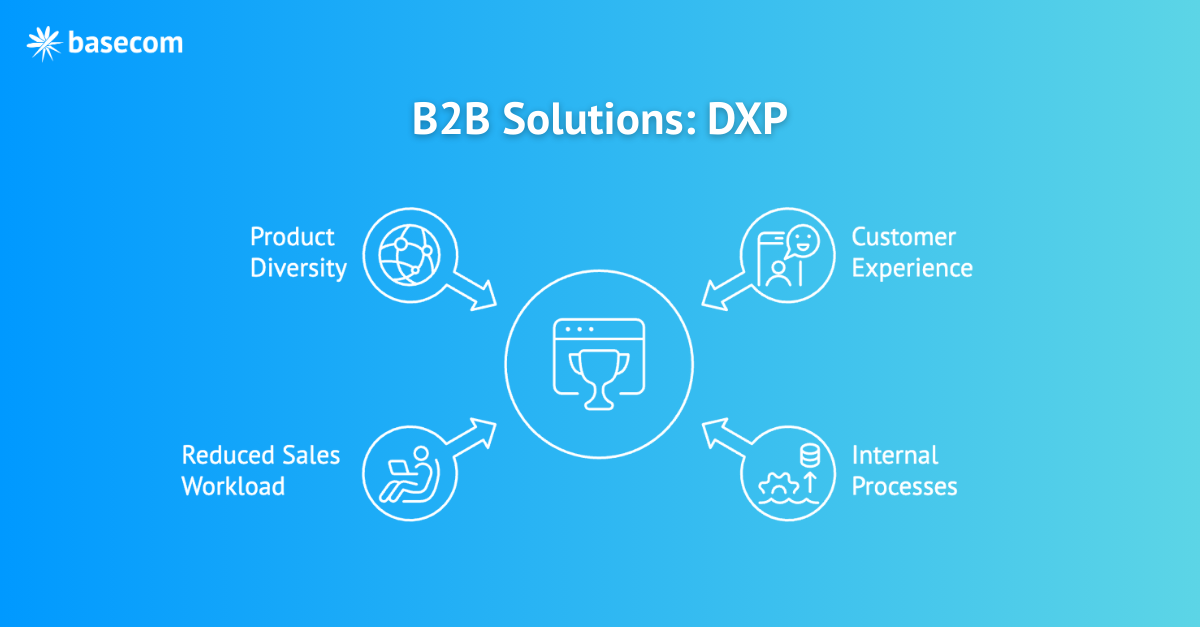
This is where Digital Experience Platforms (DXP) come in. It is not just about making products available online, but about creating a consistent and convincing customer experience across all digital touchpoints. Companies that take this step benefit from more efficient internal processes, relieve the burden on sales and secure long-term competitive advantages in a market environment that is increasingly dominated by millennial decision-makers. DXPs are becoming the decisive link between complex product worlds and individual customer needs.
- Composable architecture & headless approach for maximum agility
- Efficiency and investment protection: keeping an eye on the total cost of ownership
- Central data management as a decisive success factor
- Interactive configurators & AI for guided shopping
The challenge: complexity meets rigid system landscapes
Sales in the B2B environment is often characterized by a high number of variants and complex product logic. In addition, there are specific price and offer models as well as diverse requirements for the integration of existing systems such as ERP, PIM or CRM. This complexity makes it difficult to implement a smooth digital customer journey.
Many companies work with monolithic systems that are difficult to adapt. Product data is stored decentrally, processes are not digitalized end-to-end and new requirements can only be implemented with great delay. This results in media disruptions, error-prone processes and a user experience that does not meet the expectations of modern B2B customers.
Strategic solutions for a future-proof digital experience
Composable architecture & headless approach for maximum agility
To escape the rigidity of old systems, modern DXP solutions rely on a composable approach. Instead of an immovable monolith, the platform is built modularly from specialized components. Thanks to the API-first principle, systems such as e-commerce, CMS or marketing tools communicate seamlessly with each other. The use of headless technologies decouples the front end and back end. This enables companies to integrate new digital channels or touchpoints more quickly without having to touch the core logic of the systems. The separation ensures that designers and developers can work independently on the user experience, which drastically shortens the time to market for new features.
Careful selection of suitable best-of-breed components ensures that companies do not pay for functions they do not need, but instead receive a lean, high-performance architecture that grows with their requirements. This modular structure also protects against vendor lock-in, as individual components can be replaced if necessary without jeopardizing the entire system. In a fast-moving digital economy, this flexibility is the most important currency for remaining competitive in the long term and being able to react agilely to new market requirements.
Efficiency and investment protection: keeping an eye on the total cost of ownership
A decisive factor in the strategic decision for a technological solution is the total cost of ownership (TCO). While monolithic systems are often associated with high initial license costs and inflexible pricing models for a rigid range of functions, open DXP solutions based on a composable architecture offer significant economic advantages. The modular structure enables companies to invest specifically in the components that generate the greatest business value (best-of-breed). This not only reduces the barriers to entry, but also optimizes ongoing operating costs, as maintenance and update cycles can be controlled granularly at module level. It is possible to replace individual components without jeopardizing the entire ecosystem. This minimizes the risk of costly re-platforming projects in the long term. This flexibility safeguards investments, as the platform grows agilely with the requirements of the market and the growth of users instead of becoming a technological dead end. Reducing redundancies and avoiding licensing overheads leads to faster amortization of digitalization investments.
Central data management as a decisive success factor
Successful B2B commerce is based on trust. And trust comes from correct, consistent information. In a DXP, PIM (Product Information Management) and DAM (Digital Asset Management) systems form the central "single source of truth". This is where all technical specifications, descriptions, images and documents are centrally managed, standardized and automatically distributed to all channels. This not only reduces the error rate and returns rate for complex items, but also forms the indispensable basis for the use of artificial intelligence. Only with clean, well-structured data can AI applications such as intelligent search functions or personalized product recommendations develop their full potential.
Integrating these systems into the DXP ensures that customers always receive the most up-to-date and relevant information at every point of the customer journey. Efficient data management also relieves employees of repetitive tasks and reduces the time required for manual data maintenance. Once information is maintained centrally and synchronized everywhere, data quality increases while effort is reduced. For companies that have to manage thousands of variants and complex technical dependencies, this is the decisive lever for achieving economies of scale in digital sales and simultaneously increasing customer satisfaction through error-free information.
Interactive configurators & AI for guided shopping
The more complex the portfolio, the more important it is to have guided user interaction that provides confidence in the selection process. Digital online configurators resolve this complexity by transforming technical rules into an intuitive user interface. Customers can customize products in real time, while the system ensures in the background that only technically feasible combinations are selected. This almost completely eliminates queries and incorrect orders. Enhanced by AI applications such as intelligent chatbots for needs analysis or AI-supported guided selling, a digital sales channel is created that combines the quality of advice provided in a personal meeting with the availability of digital services. This gives sales the necessary freedom to move away from pure order clarification towards strategic customer development.
The integration of interactive tools transforms the sales process: products in need of explanation become digitally tangible and the barrier to purchase is significantly reduced through guided selection processes. Such interactive elements not only increase the conversion rate, but also strengthen customer loyalty, as users are actively involved in the design process. The use of AI also makes it possible to learn from user behavior and proactively suggest solutions that are precisely tailored to the customer's requirements. When the configurator checks the technical feasibility and the AI makes the right recommendation, the digital channel becomes the sales team's strongest partner. This creates a win-win situation: customers receive their desired solution quickly and easily, while the company sustainably increases the efficiency of its sales processes.
Fazi: DXP as the foundation for digital growth
With a modern DXP solution, companies have created the necessary flexibility to present complex products in a customer-oriented way while optimizing internal processes through automation and central data management. The move away from rigid, isolated solutions to an agile, modular ecosystem makes it possible to react quickly to market trends and meet the expectations of a new generation of buyers. It is about removing technical hurdles and putting the focus back on what counts: the relationship with the customer and the quality of the solution.

About the author
Christian Schilling is the director of the business unit Complex Productsand leads the development of configuratorware, a configuration software program. He has nearly two decades of experience in digitalization, automation, and software development.