


- Replatforming from Magento 2 to Shopware 6
- Headless frontend for an emotional customer journey
- Integrated system landscape: PIM, CMS, DAM, ERP, Loyalty
- Four country stores, API-first & scalable


Assignment
asambeauty is a manufacturer of cosmetics and skincare products and sells its products via several channels. The company places a strong focus on its own D2C online store. The existing Magento 2 system was no longer able to cope with the growth and flexibility requirements. The aim was to replatform to Shopware 6, including a headless architecture, in order to enable an emotional customer journey, international growth and close integration of commerce and content functions. In addition to the store, numerous existing systems were to be integrated - including PIM, CMS, DAM, ERP, Recommendation and Loyalty. Multilingualism, automated translations and an API-first approach were also important so that the web and app can use the same services.
basecom took over the technical implementation and supported the asambeauty team in parallel with architecture and technology consulting. This included developing a basis for decision-making, evaluating integration paths and coordinating with many stakeholders on the customer side as well as with technology partners and agencies.
Solutions and services












Challenge
The initial situation was characterized by an extensive system landscape and high demands on performance and availability. asambeauty addresses D2C target groups with strong storytelling and emotional brand experiences. This content must be efficiently maintained in multiple languages and seamlessly linked to commerce functions. At the same time, the load in the store varies greatly (e.g. through influencer campaigns or TV advertising). This resulted in high demands on the scalability, performance and stability of the platform.
In terms of organization, a large number of stakeholders were added - from product, content and marketing teams to external service providers. Content, product data, assets and personalization come from different sources. The challenge therefore lay in a clear data model, reliable integration paths and a front end that combines emotionality, advice (guided shopping) and efficient purchasing processes.
Solution
Replatforming to Shopware 6
The existing commerce platform was migrated to Shopware 6. The decision was made in favor of a setup that enables rapid further development, modular expandability and the use of sales channels. This allows country stores, product ranges and payment/shipping profiles to be clearly separated and controlled. Existing store functionalities were reviewed, implemented with standard functions where possible and supplemented with a range of individual extensions. Thanks to the API-first architecture of the commerce platform, the store front end and app can access shared services. The platform was implemented as a cloud-based PaaS solution.
Headless Frontend with Shopware Frontends
A headless frontend based on Shopware Frontends was implemented for maximum design freedom and performance. This allows UI elements and content to be implemented precisely for an emotional, consultative journey. For example, through individual steps for care routines, sets & bundles, cross-selling and upselling as well as extensive ingredient and application information. The headless approach also simplifies the connection of external systems (CMS, DAM, recommendation) and enables fast iterations without deep intervention in the Shopware core. The headless solution for asambeauty is one of the first implementations with Shopware Frontends on this scale.
Content & product data architecture
The maintenance of product data and content is distributed across various systems: Product and master data in the PIM (Akeneo), editorial and SEO content in the headless CMS (Contentful), media in the DAM. This "best-of-breed" setup reduces the workload for specialist departments, speeds up content creation and ensures good data quality.
Akeneo (PIM)
Akeneo is the source for structured product information - from SKU, EAN/GTIN and variants to sets/bundles. The attribute model was structured in such a way that filters, facets and comparison functions can be mapped in Shopware. Reference entities ensure consistent data across all channels. Completeness and quality rules ensure that mandatory fields are filled and values are valid. Channel and locale control separate markets and languages.
Economic data such as price and stock remain in the ERP and are only referenced in the PIM. Akeneo refers to assets in the DAM by key and transfers differential updates to Shopware/Frontend via the integration layer.
Contentful (Headless CMS)
Contentful provides the editorial building blocks of the journey. Dedicated content types (e.g. category intro, experience worlds and routine steps) and additional SEO fields (detailed descriptions, product benefits) enable a consistent page structure. Content is localized, translations are triggered via Crowdin and controlled via status/release. Content modules reference product IDs from Akeneo and access media from Canto. Publications trigger cache invalidations and previews/updates in the headless frontend via webhooks, keeping pages fast and up-to-date. For product detail pages, the systems from which information is made available are clearly defined: Product data comes from Akeneo, story and advice content from Contentful, media from Canto. The front end compiles the information in a user-centric way - with fallback logic, clean caching and high performance.
Personalization & recommendations
Odoscope was connected for recommendations and dynamic product suggestions. This creates relevant upselling impulses along the journey. For example, through suitable additions to the shopping cart or alternatives on product lists. The services are connected headless and can be reused in different frontend contexts. The setup remains interchangeable if future requirements call for other tools or logics.
Internationalization & translations
asambeauty operates several country stores. Multilingual content is organized via an automated translation workflow with Crowdin. This reduces manual effort, accelerates time-to-market and ensures consistent terminology. The Shopware sales channels as well as country and channel-related configurations (product ranges, payment methods, taxes, loyalty points) allow a clean separation per market - with a common code and component base.
Integration & data flows
The system was integrated via Celigo’s iPaaS integrator.io and targeted direct connections. This ensures that ERP, PIM, DAM, recommendation and loyalty data are reliably merged. The central goal was a robust, decoupled data model: economic master data from the ERP flows into the PIM, where it is enriched with marketing attributes. Digital assets are delivered from the DAM. The front end consumes these sources via APIs and makes them available in the right context.
UX, UI & guided shopping
UX played a central role right from the start. User needs, information hierarchies and interaction patterns were worked out in intensive workshops and refinements. The UI agency Silberplus provided layouts, while basecom took on sparring, technical evaluation and implementation in the headless stack. Special attention was paid to the balance between emotion and efficiency: large-format imagery, clear product information, routines, sets and trust elements (e.g. loyalty) were combined in such a way that orientation and conversion were right.
Payments, shipping & loyalty
In addition to the PSP, shipping service providers were connected directly in order to keep stocks, delivery times and status messages synchronized. Payback was integrated on the store side - including secure communication via a VPN provided by Payback and end-to-end points logic along the customer journey (display, calculation, credit). In addition, services such as address verification/completion were added to reduce checkout friction.
Scaling & operation
For marketing and TV peaks, the infrastructure was designed together with Shopware and the hosting partner in such a way that peak loads can be absorbed. Caching strategies, asynchronous processes and monitoring ensure stability and short response times. The decoupled architecture makes it easier to optimize or replace individual components independently.
Collaboration & consulting
The project was characterized by intensive, ongoing consulting - from architecture decisions (ADRs) to integration paths and data responsibilities. basecom worked closely with the customer team, an internal developer and external project management. Parallel teams (e.g. for app development and infrastructure) were integrated via clear interfaces and regular coordination.
Conclusion
The project combines commerce, content and data to create a consistent customer experience - headless, API-first and internationally scalable. The combination of Shopware 6, a high-performance headless frontend and a clearly structured integration architecture enables fast iterations, flexible content and stable processes even under high load.
The close, cross-disciplinary collaboration was challenging due to the complexity of the project. basecom delivered the project in close cross-disciplinary collaboration: several country stores went live in quick succession, and the system is easily expandable thanks to decoupled components.
Impressions

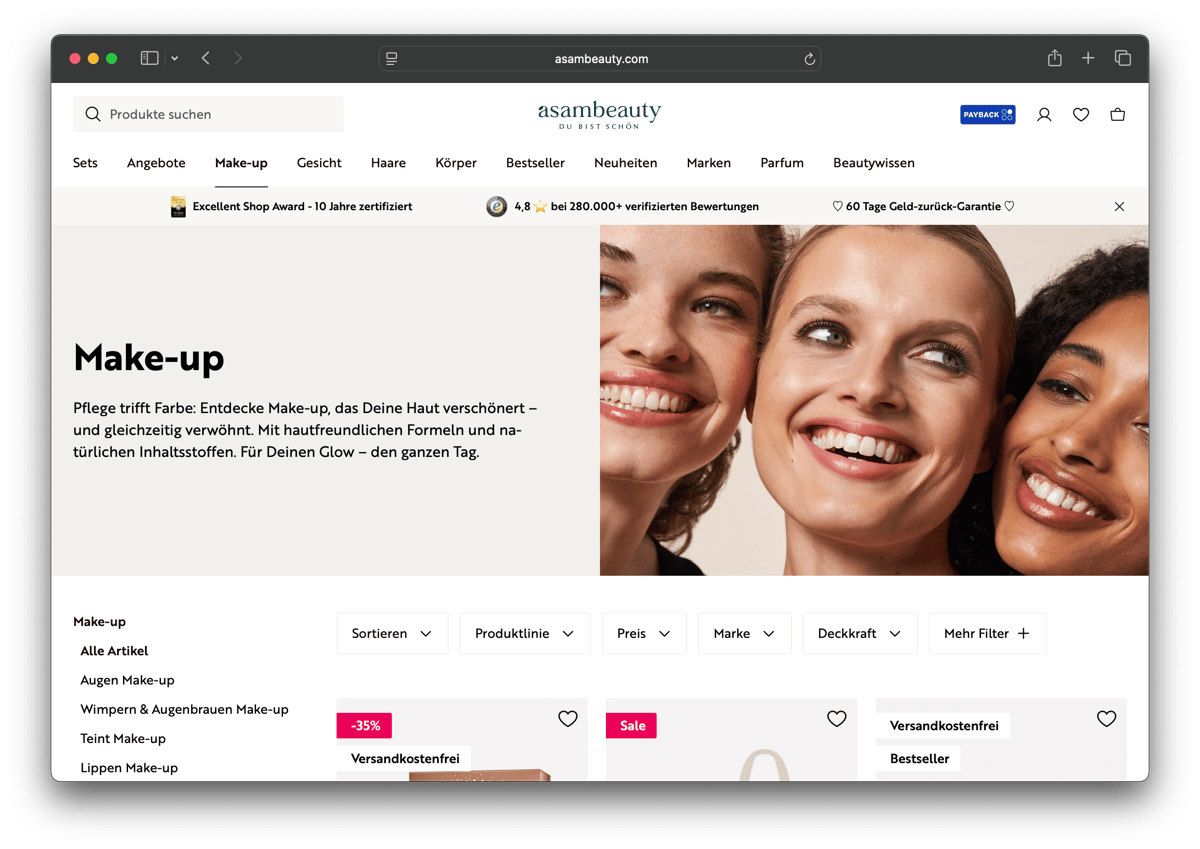
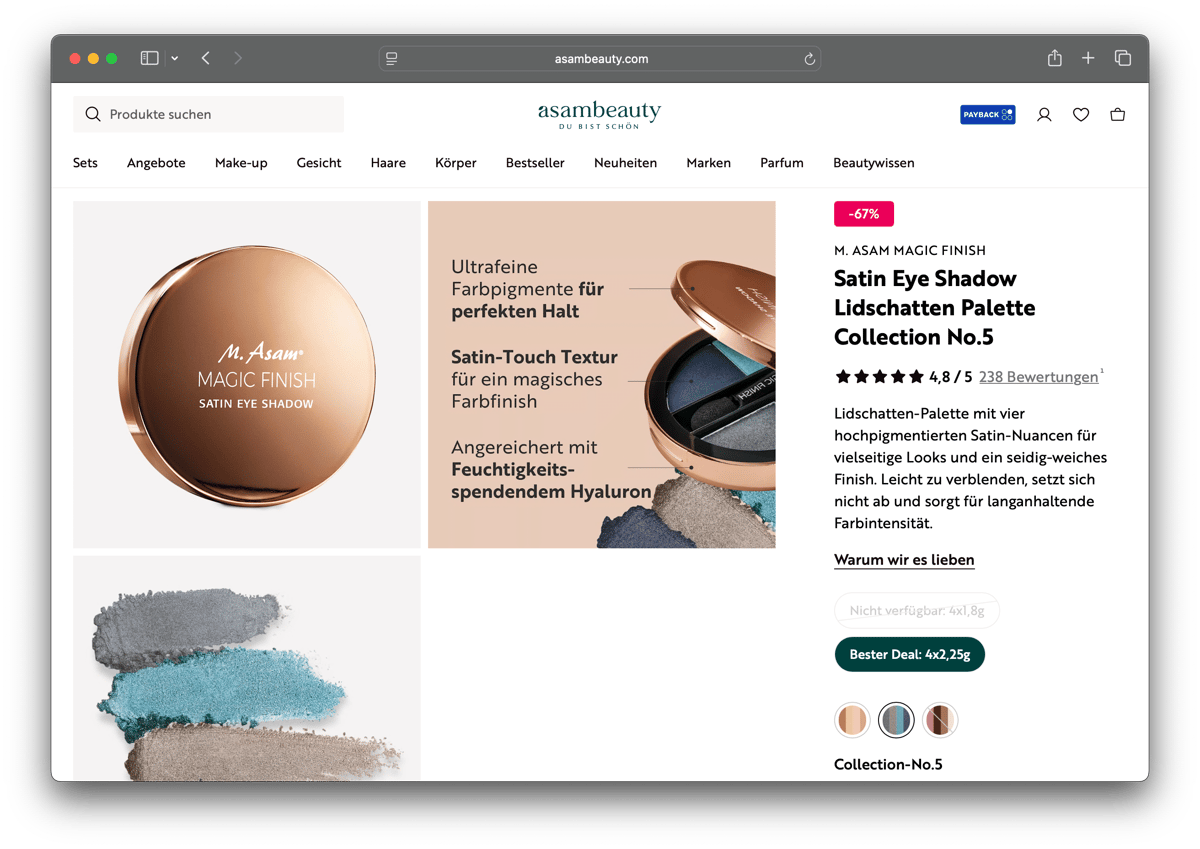
The D2C store from asambeauty was implemented on the basis of Shopware 6.

Jonas Dambacher, CSO