
Spryker Commerce OS: E-Commerce Systems in Comparison Part 8
Spryker Commerce OS - Ready for disruption
Spryker has been on the market with its e-commerce platform Spryker Commerce OS since 2014 and has been causing quite a stir in the industry ever since. Unlike other e-commerce and shop systems, Spryker positions itself as a commerce operating system that serves as the foundation for highly customized and technically sophisticated commerce solutions.
Behind the Berlin-based company are Alexander Graf and Co-Managing Director Boris Lokschin, entrepreneurial personalities with considerable experience in the e-commerce and start-up sector. The target segment for the Spryker Commerce OS is defined less by revenue or size and more by potential customers’ need for a system that is fast, reliably scalable, and extremely flexible. Spryker is therefore particularly well-suited for tech-driven companies that rely on innovative business models. Spryker is listed as a 'Visionary' in the 'Magic Quadrant for Digital Commerce' 2025. Spryker can point to a number of well-known references from both the B2C and B2B sectors. In addition to enterprise customers such as ALDI SÜD or Siemens Healthineers, Spryker's portfolio also includes large SMEs such as Hardeck and Grimme. They are all united by the need for a flexible, modern and high-performance digital commerce solution.
What does Spryker do?
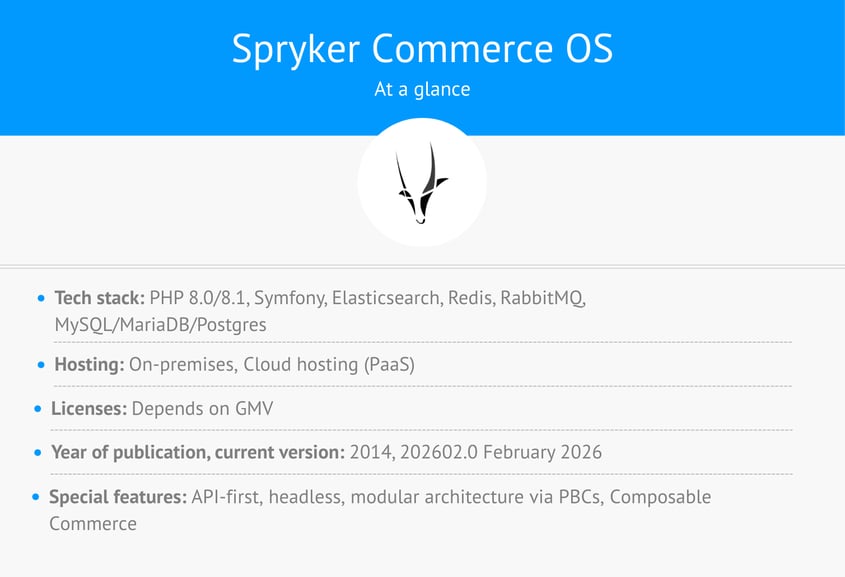
The Spryker Commerce OS focuses first and foremost on flexibility. Spryker is therefore built according to the API-first principle and follows the headless approach. Backend and frontend are separated from each other, so that the system is not fundamentally tied to a specific frontend application. In addition to a classic store frontend, a PWA, an IoT or voice commerce application can also be connected, for example - there are no limits to the freedom here. However, Spryker is not only very flexible in terms of the front end. Thanks to its modular structure, the system itself can also be highly customized. Various features are provided in individual, independent module packages or Packaged Business Capabilities (PBC), which can be combined as required. This keeps the system very lean from the outset, as there is no unnecessary ballast. The costs and risk of developing and maintaining the system can thus be kept low, as the various modules can also be further developed, maintained or replaced independently of each other without affecting the system as a whole.
With its Commerce OS, Spryker offers a very powerful and highly scalable system that enables online retailers to quickly implement and test new features in order to adapt to new market trends or help shape them as digital leaders. Spryker offers the system as a platform-as-a-service solution Spryker Cloud Commerce OS. The infrastructure is provided and maintained by the manufacturer, while the system can still be individually developed and customized. The PaaS+ version is also available, which provides additional manufacturer services such as updates to individual modules.
Digital products & disruptive business models
When it comes to headless and API-first, providers such as Shopware have also followed suit. However, Spryker goes one step further with its modular approach. The Commerce OS is designed to develop innovative commerce solutions for disruptive business models. With Spryker, a very high degree of individualization can be achieved. The idea here is to focus on the technology as a digital product and thus gain a competitive advantage. Spryker combines this idea with a strong plea for the MVP approach and agile methods. As a question keeps coming up in this context, it should be answered briefly here too: Yes, an out-of-the-box store can also be used with Spryker. Spryker offers a complete B2C store as well as a B2B store and a marketplace solution, each of which only needs to be adapted and populated. It is therefore possible to develop your own commerce solution based on an existing system. However, Spryker's focus is clearly on offering a technical basis for high-performance, scalable and flexible headless systems. Unlike Shopware 6, which follows a similar structure—at least in principle—Spryker features an even more granular structure that, on the one hand, ensures maximum flexibility but, on the other hand, also demands significant resources in terms of software development. To illustrate this a bit more clearly: The difference between Shopware and Spryker is like the difference between Lego and Fischer Technik. As the possibilities offered by the various systems increase, so does the complexity. The cloud commerce platform commercetools takes a different approach to Spryker. As a MACH solution, it is microservices-based, API-first, cloud-nativeand headless. commercetools is based on a modular architecture made up of microservices. These microservices are independent of each other and are provided as software-as-a-service. This means that they are also maintained and operated by commercetools. Microservices are smaller than the PBCs at Spryker. This means that commercetools can also implement very individual solutions. However, unlike with Sypryker, there is no intervention in the system itself.
In order to map individual business logic, for example, separate microservices must be developed and integrated into the commerce landscape via API in the sense of composable commerce. The Spryker Commerce OS, on the other hand, also allows very far-reaching interventions so that the business logic in the system can be completely customized. Just like the Spryker Commerce OS, the Pimcore Digital Commerce Framework is a flexible framework for creating individual commerce solutions. However, while Pimcore offers its commerce solution as a supplement to the Pimcore platform, which focuses on data management, Spryker clearly concentrates on the further development of its commerce system. In order to connect third-party software such as ERP or PIM systems, Spryker provides its own middleware that enables seamless integration. Spryker also released its App Composition Platform (ACP) in 2023 and announced plans to expand it further. The APC enables users of the Spryker Cloud Commerce OS to integrate third-party services (e.g. Algolia or Payone) via an app. The apps provided in the ACP are certified by Spryker and can be integrated into the system with little or no development effort.
Conclusion
Spryker is the right e-commerce software for companies that want to operate dynamically and agilely in online retail in order to attract and retain customers with new, innovative offers. The Spryker Commerce OS positions itself against the competition on the market as an uncompromising headless solution with maximum flexibility and customizability and relies entirely on the best-of-breed approach. Through technology ownership, users of the system gain independence, while Spryker simultaneously offers the technical requirements to drive innovation and test and further develop new digital products.
Spryker covers a correspondingly wide range of applications, but is primarily aimed at medium-sized and larger companies with a clear focus on complex, individual or technically sophisticated or innovative business models. A good example of this is our joint project with the retail company ALDI SÜD, in which the Spryker Commerce OS is used in connection with the SHOP&GO cashierless store concept to map the automatic payment process via an app.
On the corporate side, the Spryker Commerce OS requires a willingness to provide or build up technical expertise: Technology ownership requires that you also adopt a technology. In this respect, Spryker differs significantly from Shopware 6, which is also very flexible, but primarily offers online retailers a store system that works according to the principle of "configuration before programming". Although Spryker also offers a preconfigured out-of-the-box store, the focus here is clearly on individual commerce solutions that go beyond an online store. The initial costs for a Spryker project can therefore be relatively high compared to simple store solutions, but also depend very much on the individual requirements. However, as the system usually remains rather lean overall due to its modular structure, maintenance costs are usually comparatively low, meaning that the total cost of ownership (TCO) is low over the software's service life. In any case, a thorough requirements analysis is ultimately essential for selecting a suitable e-commerce solution.
More e-commerce systems in our comparison:
Free download
In our new white paper, “E-Commerce Systems in Comparison 2026,” we compare eight innovative e-commerce solutions and provide a detailed overview of the advantages and unique features of each system.
Download