
Shopify Plus: E-Commerce Systems in Comparison Part 6
With the cloud-based e-commerce platform Shopify Plus, Shopify offers a version of its store system that is aimed specifically at large companies. Shopify Plus has been part of our e-commerce portfolio since 2023. In the sixth part of our e-commerce system comparison, we introduce you to this enterprise e-commerce platform.
Shopify Plus - SaaS platform for dynamic scaling
Shopify was founded in 2006 and has been listed on the New York Stock Exchange since 2015. The Canadian company based in Ottawa has grown very strongly since then. With around 2.5 million active stores, Shopify is in second place worldwide (behind the WordPress solution WooCommerce), according to the portal Store Leads. The basic version of Shopify is tailored to small and medium-sized e-commerce projects in the B2C and D2C sectors and enables companies to quickly and easily launch an online store on the market. The store software is provided as a cloud service and requires no special prior knowledge to use.
In addition to this basic version, Shopify has been offering an enterprise version of its SaaS platform, Shopify Plus, for some time now (which has been available in the DACH region since 2020). Shopify Plus provides additional functions, extended APIs and very powerful and scalable cloud hosting. The smooth integration of third-party systems, such as PIM or ERP, is supported by the Shopify APIs and Shopify SDKs (Software Development Kits). According to Store Leads, Shopify Plus is currently used by more than 28,000 stores. In German-speaking countries, the Store Leads portal identifies 1467 web stores that are based on Shopify Plus (as of May 2023).
In the Gartner Magic Quadrant for Digital Commerce, Shopify (or Shopify Plus) is listed as a 'Leader' in 2024. According to Gartner, Shopify Plus is predominantly used by medium-sized companies, but is also growing rapidly in the enterprise market. The analysts praise Shopify for its innovative strength and point out that the company invested 1.73 billion dollars in research and development in 2023. According to the experts, the SaaS platform is well-suited for companies that prioritize a fast time-to-market.
What does Shopify Plus have to offer?
Shopify Plus is a cloud-based SaaS offering with a strong focus on user-friendliness, performance, scalability and time-to-market. With this system, online retailers benefit from automatic updates, meaning that a large part of the maintenance work is eliminated, while the range of functions is constantly being expanded. The cloud infrastructure also ensures very high availability. Additional resources can be provided automatically during peak loads. Shopify promises unlimited bandwidth and web hosting at no additional cost.
Just like the basic version of Shopify, Shopify Plus is easy to get started with and offers very user-friendly administration. The standard version of Shopify Plus includes all the basic features needed to quickly launch an online store as an MVP (Minimum Viable Product). Additional features can be added via an app from the App Store. Shopify Plus can also be customized. Functional extensions and third-party systems can be connected via the extensive APIs, meaning that a store project can be scaled from an MVP to a very large system. The subsequent integration of complex features such as an external search (e.g. Algolia) or a headless CMS (e.g. Contentful or Storyblok) is also relatively easy to implement.
Shopify Plus supports multi- and omni-channel strategies with a variety of responsive themes and the connection of social media channels and online marketplaces. Content can thus be easily displayed on mobile devices or played out in other channels. Shopify Plus also includes the Shopify POS feature, which can be used to merge online and offline commerce in a digital-first approach. For example, click-and-collect solutions can be implemented, showroom concepts can be linked to the online store and returns management can be managed via the platform.
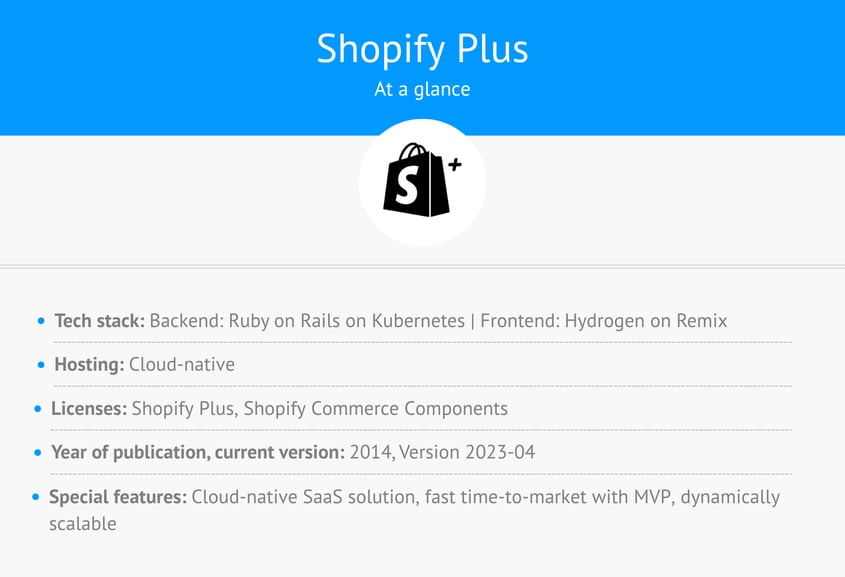
In 2022, Shopify released the headless commerce stack Hydrogen. Hydrogen provides extensive development tools for the development of individual storefronts that are optimized for Shopify Plus. Hydrogen offers templates and pre-built components that are aligned with Shopify APIs, as well as hooks and utilities to facilitate the creation of individual front-end solutions. The framework ensures that the exchange with Shopify core features such as order and payment processing or data and product management functions smoothly. With Oxygen, Shopify also provides a hosting solution for Hydrogen Custom Storefronts. In this combination, Shopify offers the opportunity to implement high-performance, customized store solutions.
Hydrogen is based on the open source technologies Remix, GraphQL and Tailwind. The implementation of Hydrogen frontends (or any other headless frontend) requires expertise in the field of frontend development. For companies that do not have the capacities needed themselves, it is advisable to work with specialized agencies or software service providers that have expertise and experience in the areas of e-commerce and front-end development.
Extensive features & attractive license model
With an entry-level price of around $2,000 per month including cloud hosting and comprehensive manufacturer support (Merchant Success Program), Shopify Plus is a relatively affordable offer. The SaaS commerce platform provides numerous functionalities out of the box. These include a very high-performance and customizable checkout, Shopify POS, automated workflows in the admin area and the option to integrate AR, video and 3D media on the product pages.
With B2B on Shopify, Shopify Plus also provides a range of B2B features so that, for example, company profiles can be created with various authorizations or self-service offers can be set up. With Shopify Markets, the platform also offers a toolset to support companies in the global expansion of their online offering.
A variable fee option is available for complex projects with higher sales volumes that place additional demands on the platform. Additional costs may arise from the use of third-party apps, the development of an individual storefront or the integration of third-party systems by a Shopify partner agency.
Shopify Commerce Components
At the beginning of 2023, Shopify launched another offering for companies in the enterprise segment. Shopify Commerce Components allows businesses to use individual modular components of the software and integrate them into their existing commerce ecosystem or combine them with other web applications in a new project using a best-of-breed approach. As a result, companies can benefit from more than 30 of these commerce components, which are already being used very successfully as part of the Shopify platform. Components such as the Shopify checkout can thus be integrated with third-party systems independently of the commerce platform. Instead of buying a license for the entire store system, individual modules can be selected as required.
Shopify is thus opening up its platform for API-centered composable commerce projects, bringing it closer to MACH technologies such as commercetools.
Shopify Magic & AI Assistant Sidekick
Since 2023, Shopify has been expanding its platform with AI-based functions that help merchants automate processes and improve customer experiences. Under the name Shopify Magic, the company bundles a range of generative AI features that are integrated into different areas of the system. These include tools for automatic text creation for product descriptions, SEO titles and emails as well as intelligent suggestions for discount campaigns, customer communication or blog posts. These functions draw on Shopify's extensive database, enabling the creation of customized content based on the style and target groups of the respective brand.
Shopify Magic is complemented by the new AI assistant Sidekick, which acts as an interactive companion in the administration. Sidekick can answer questions, take on tasks and make contextual recommendations - for example to optimize product pages, set up new functions or analyse sales data. Thanks to the close integration with the system, Sidekick is able to carry out specific actions directly, such as creating products or starting workflows. For retailers, this means a significant reduction in operational workload and a lower entry barrier when using more complex features. Shopify is positioning itself as one of the first e-commerce platforms to integrate AI not just as an add-on, but as an integral part of the workflow, thereby enabling particularly small and medium-sized businesses to benefit from data-driven automation.
-
Conclusion
Shopify Plus is a very powerful SaaS solution that is particularly suitable for e-commerce projects that require a short time-to-market and the ability to scale rapidly. In particular, companies in the B2C sector and D2C brands that sell relatively simple products (e.g. fashion) in large quantities or have to cope with high peak loads during promotions, for example, should consider Shopify Plus. For many companies in these sectors, the omnichannel functionalities such as Shopify POS or the marketplace and social media connections also make Shopify Plus interesting.
Shopify Plus also offers some specific functionalities for companies operating in the B2B environment. However, B2B projects that are associated with very individual and complex requirements will reach their limits here. Shopify is thus positioning itself as one of the first commerce platforms to integrate AI not merely as an add-on, but as an integral part of the workflow, thereby enabling small and medium-sized businesses in particular to benefit from data-driven automation.
While third-party systems such as ERP or PIM systems can be connected to the Shopify platform and additional functionalities can be implemented via apps, deeper modifications to the core of the system are not possible here. In this respect, the Shopify Plus SaaS platform differs from alternative solutions such as Magento, Pimcore, Shopware or Spryker, which are open source-based and allow deep interventions in the business logic.
Shopify Plus is available exclusively as a cloud-based SaaS solution. Companies for which hosting on their own servers is a critical requirement must switch to a different system.
In our view, Shopify Plus is a strong commerce solution that is a good alternative in many use cases. The SaaS platform is therefore a valuable addition to our portfolio and a further building block that enables us to offer our customers an e-commerce solution that is ideally suited to their individual requirements.
More e-commerce systems in our comparison:
Free download
In our new white paper, “E-Commerce Systems in Comparison 2026,” we compare eight innovative e-commerce solutions and provide a detailed overview of the advantages and unique features of each system.
Download