

Shopware: E-Commerce Systems in Comparison Part 7
Shopware – Flexibility and Scalability for B2C and B2B
Shopware 6 was released at the end of 2019 and set out to provide an "answer to the challenges of a complex, constantly changing e-commerce world". After the release, Shopware spoke confidently of "a new technological Shopware generation" that replaces the previous version, Shopware 5. And the Münster-based company has indeed taken a significant step towards the future with the major update of its store system and continued its success story with Shopware 6.
In February 2022, shopware AG announced that it had raised 100 million US dollars in growth capital through a new partnership with Carlyle and PayPal, which will be used for Shopware's international expansion and the development of new products. In 2025, PayPal acquired Carlyle's stake, increasing its stake in Shopware to 41 percent.
In September 2022, Shopware presented a new product and license plan with which the company is repositioning its offering. With the Shopware Rise, Shopware Evolve and Shopware Beyond editions, three variants of the store system are available, which are staggered in terms of performance, service level and license costs to meet the needs and requirements of different company sizes and business models.
In 2024, Shopware was named a 'Leader' in the IDC MarketScape Report for Headless Digital Platforms for SMEs and recognized as a 'Major Player' in the IDC MarketScape for B2B Digital Platforms for SMEs. After Shopware was first classified as a 'Niche Player' in the 'Magic Quadrant for Digital Commerce' in 2024, Shopware moves up into the ranks of the 'Visionaries' in the current Magic Quadrant of 2025.
The analysts particularly highlight innovations in the areas of 3D and augmented reality, the digital sales room and existing and planned AI functionalities.
What does Shopware have to offer?
Under the motto "Your freedom to grow", Shopware has been continuously developed since the release of Shopware 6 (2019) into an open commerce platform that offers companies extensive opportunities to grow online. This claim is also reflected in the new edition and license model.
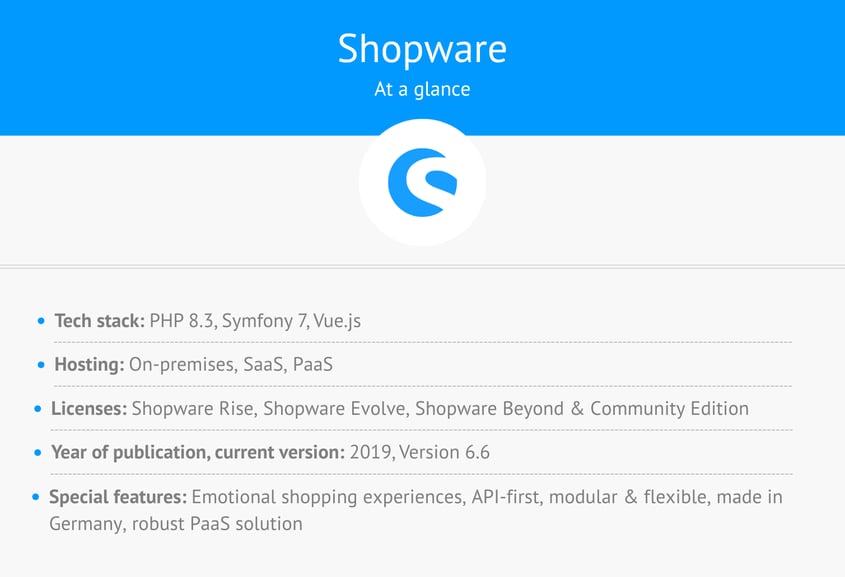
Shopware comes with a whole range of attractive features and a fresh technology stack: The current version of Shopware uses the frameworks Symfony (version 7 LTS, full stack), Vue.js and Bootstrap as well as PHP 8.3 and the template engine Twig. With this stack, Shopware is at the cutting edge of technology. This is noticeable in the excellent performance and scalability and at the same time underpins the Münsterland-based company's commitment to the open source concept.
Shopware continues to rely on an active developer community and a wide range of plugins to expand the system. However, Shopware gains additional flexibility in particular through its software architecture based on the API-first principle, which enables easier integration of external systems (e.g. ERP, PIM or CRM systems) and the connection of different front-end applications. As a headless system, Shopware opens up new possibilities for store operators with regard to multi-shop concepts, connection to marketplaces and innovative front-end solutions such as Shopware front-ends. Compared to monolithic software architectures, the API-first approach also offers the possibility of lowering development costs and reducing risk by allowing the system to be developed and expanded on a modular basis.
New edition model for flexible & dynamic growth
Shopware focuses on clarity, clear navigation, simple, intuitive usability and fast administration. Shopware attaches great importance to content management and marketing. Particular importance is attached to the experience worlds, which, as a consistent further development of the shopping worlds known from Shopware 5, offer the possibility of creating various store pages (landing pages, category pages, product detail pages, listings) very easily and simply via drag & drop. Different content elements such as products, text elements, images or media can be arranged directly in the administration and can be displayed across devices and channels.
Shopware is offered in four versions, which differ in their scope of services: In addition to the free Community Edition, which is particularly interesting for tech-savvy companies that have their own expertise in software development, there are the Shopware Rise, Shopware Evolve and Shopware Beyond editions, which replace the previous Professional Edition and Enterprise Edition.
The various Shopware editions differ in terms of the features available, the level of support included and the license costs. The Shopware Rise edition is available from EUR 600 per month. It is aimed at companies that want to set themselves apart from the competition with a professional online offering. The license offers features such as Premium Themes and Custom Products as well as Flow Builder and Rule Builder functions to create a unique and recognizable online presence, automate workflows and present products in the best possible way.
The Shopware Evolve edition offers additional functions and a more extensive range of support. The features of this edition include B2B components and advanced search. Shopware Evolve is aimed at companies that want to flexibly expand and scale their online business at a higher level and is particularly interesting for B2B business models.
The Shopware Beyond edition offers the most comprehensive range of functions and support. This is an enterprise solution which, in addition to the features of Shopware Evolve, provides extended functions in the Rule Builder and Flow Builder as well as customized prices or Guided Shopping.
Thanks to the structure of the license and edition plan, Shopware offers retailers a very good basis for flexibly developing and scaling their online offering. All commercial Shopware editions can be hosted on-premises or provided by Shopware as a cloud-based SaaS or PaaS solution.
Shopware PaaS
With Shopware PaaS (Platform-as-a-Service), Shopware offers companies a technology to drive innovation faster that adapts flexibly to their individual needs. Shopware's experts take care of the complex infrastructure management so that companies can concentrate fully on their business success. Shopware PaaS is fast, scalable, secure to develop and implement, and developers have full access to Shopware's core components. This enables the optimal use of customer data and offers maximum flexibility, managed scaling as well as DevOps and monitoring tools, which significantly reduces fixed development costs and the total cost of ownership. Shopware PaaS combines the flexibility of an open ecosystem with structured interfaces for backend and frontend, enabling more efficient development and deployment of projects. Developer productivity can be increased by up to 40% and DevOps complexity can be significantly reduced. Shopware PaaS builds a bridge between self-hosting and SaaS offerings, enables fast system deployment, minimizes maintenance effort, and allows early testing of new features as well as flexible up- and downscaling.
Shopware AI & Agentic Commerce
Shopware has been providing users with a range of AI features since 2024, which have since been expanded and have been part of the platform since 2025 under the name Shopware AI. Shopware AI is directly integrated into the administration interface. At its heart is an AI-supported chat assistant that answers users' questions contextually and in real time. The AI assistant provides precise information on feature usage, set-up questions or best practices based on individual store configurations and versions.
The Agentic Commerce Alliance was founded in 2025 on the initiative of Shopware. As an association of AI-based technology companies, researchers and retailers, the Agentic Commerce Alliance is committed to laying the foundations for open, agent-based commerce: common standards, interoperable agents and data sovereignty for retailers. The Agentic Commerce Alliance brings together AI commerce experts to lead merchants into the future of commerce. basecom is a founding partner of the Agentic Commerce Alliance.
For more information, please visit https://agentic-commerce.org/.
Conclusion
Shopware's flexible store system is available in a free Community Edition. However, many features are only available in the paid versions. With the new license plan, Shopware also offers smaller companies an affordable, professional e-commerce system with the Shopware Rise edition to develop an attractive, individual offer with their own online store. Shopware Evolve and Shopware Beyond are aimed at larger and bigger companies with a sales target of around EUR 5 million or more in online retail. These two editions offer extensive B2B features such as customer-specific prices and the control of rights, roles and approval processes. Store operators also have a range of attractive additional functions and extensive configuration and design options at their disposal. These include customizable products as well as the integration of additional sales channels such as Facebook, Google Shopping or voice commerce channels. The Rule Builder, which can be used to create individual pricing or shipping rules, for example, can also be used for CMS elements in these editions. At the end of 2021, a new key feature was released in the form of the Flow Builder, which can be used to define and automate individual workflows. The Flow Builder is designed as a no-code interface so that even complex business processes can be set up and automated via the intuitive, user-friendly interface. Examples include customer-specific delivery options, individualized ordering and payment methods or the automation of internal business communication. Webhooks can also be used to transfer data to API-based third-party systems. Shopware is therefore an interesting solution for very different target groups.
Shopware is designed according to the API-first principle and therefore offers the option of controlling the system via programming interfaces or connecting various front-end applications, e.g. Alexa skills or IoT applications, via the SalesChannel API. Shopware can therefore also be operated completely as a headless system. However, unlike Spryker, Pimcore or commercetools, Shopware sees this approach more as an offer and investment in the future viability of the system. The Münsterland-based company continues to focus on offering companies a powerful and easy-to-use store system. For store operators and marketing teams, Shopware offers numerous features that enable extensive options for designing and customizing the store from the administration. The motto here is: Configure before programming.
As a Shopware Platinum Partner, we can advise you on all aspects of Shopware and are happy to support you in the implementation of your Shopware project.
More e-commerce systems in our comparison:
Free download
In our new white paper, “E-Commerce Systems in Comparison 2026,” we compare eight innovative e-commerce solutions and provide a detailed overview of the advantages and unique features of each system.
Download
About the author
As Chief Sales Officer at basecom, Jonas Dambacher helps companies identify and effectively leverage digital opportunities from the initial consultations to the actual implementation. His focus: solutions that not only work technically but also deliver measurable results toward business goals. Jonas ensures that initial discussions turn into real projects—and that projects turn into competitive advantages.
.png?width=256)